More and more people have been asking me about IRMAA, so let’s break it down clearly. In finance we already have enough abbreviations, but this one is worth knowing.
IRMAA stands for Income‑Related Monthly Adjustment Amount. It’s the Medicare surcharge added to Part B and Part D premiums when your income exceeds certain thresholds. And because Medicare uses a two‑year lookback, your current premiums are based on your tax return from two years ago.
So if you retire at 65, Medicare is looking at your income at 63. If that return isn’t processed yet, they use the next most recent year which is why age‑64 income can matter too.
Why IRMAA Is Important for Retirement Planning
In retirement, many people get to do what I call “choose their income.” You decide:
How much to withdraw
Which accounts to pull from
How to structure your investments
When to realize capital gains
Whether to do Roth conversions
All of these decisions affect your MAGI, and therefore your Medicare premiums.
Paying more isn’t always bad sometimes it’s the right move for your goals. But you should know the rules so you can make informed decisions instead of accidental ones.
A client recently told me about his family members, who have an advisor and had never heard of IRMAA until they retired. They learned quickly. Unfortunately, they learned the expensive way.
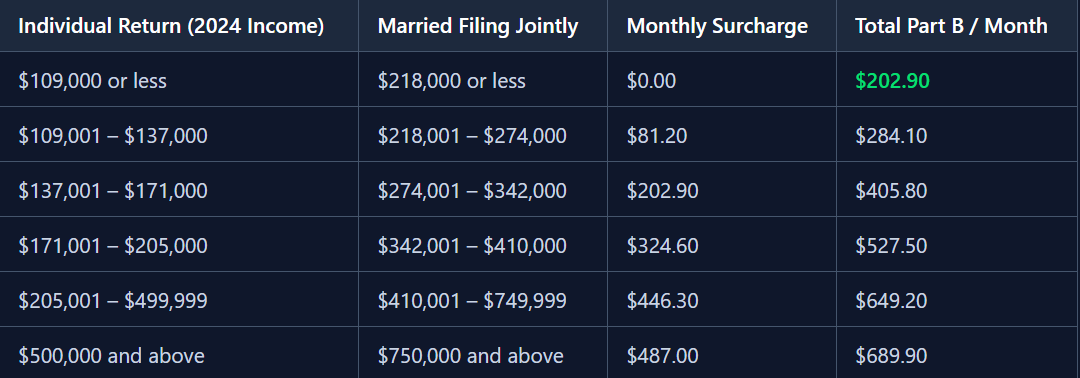
Part B IRMAA
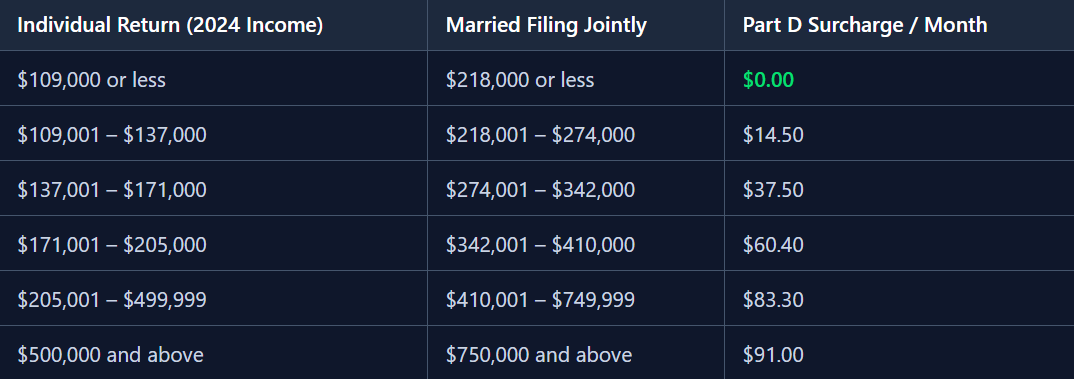
Part D IRMAA
What This Means in Real Life
Let’s use your example:
Married couple with $274k–$342k MAGI (2024 return → 2026 IRMAA):
Part B surcharge: $202.90 × 2 people × 12 months = $4,869.60/year
Part D surcharge: $83.30 × 2 people × 12 months = $1,999.20/year
Total IRMAA impact: ≈ $6,870/year
And remember IRMAA is per person, not per household.
The IRMAA Cliff (No Phase‑Outs)
IRMAA is a cliff system:
If your MAGI is $1 over a threshold, you move to the next bracket immediately.
There is no gradual phase‑out.
Because of the two‑year lookback, a mistake today can cost you two years of higher premiums.
This is why planning matters.
Strategies to Reduce IRMAA Exposure
Here are some of the most effective tools:
1. Asset Location
Place tax‑efficient investments in taxable accounts and income‑producing assets in tax‑deferred accounts to reduce MAGI.
2. Diversified Withdrawal Strategy
Blend withdrawals from taxable, tax‑deferred, and Roth accounts to control income.
3. Charitable Planning
Tools like QCDs (after 70½) or donor‑advised funds can reduce taxable income in high‑income years.
4. Manage Capital Gains
Harvest gains strategically or avoid realizing large gains in IRMAA‑sensitive years.
5. Roth Conversions (Done Intentionally)
Conversions can be smart but poorly timed conversions can trigger IRMAA for two years.
6. Understand Cash Flow vs Income
You can have high cash flow with low taxable income if your accounts are structured correctly.
Bottom Line
IRMAA isn’t a penalty; it’s a planning variable. Handled well, it’s just another lever in your retirement strategy. Handled poorly, it’s an expensive surprise.
Frequently Asked Questions
IRMAA stands for Income-Related Monthly Adjustment Amount. It is a surcharge added to your Medicare Part B and Part D premiums when your income exceeds certain thresholds. The higher your income, the higher your Medicare premiums may be.
Medicare uses a two-year lookback period, which means your current premiums are based on your tax return from two years prior. For example, if you turn 65, Medicare examines your income from age 63. If that return hasn't been processed yet, they may use your age 64 income instead.
In retirement, you control decisions like withdrawal amounts, which accounts to draw from, when to realize capital gains, and whether to do Roth conversions. All of these choices affect your Modified Adjusted Gross Income (MAGI), which directly determines your IRMAA surcharges.
Not necessarily. Paying higher Medicare premiums through IRMAA isn't always unfavorable if it aligns with your overall financial goals and retirement plan. Understanding the rules allows you to make informed decisions rather than learning about IRMAA's impact unexpectedly after retirement begins.